
A journey from the corporate world to the calm rhythm of Bodrum and the durable fragility of stoneware. Su Başkan discusses her production practice, which embraces imperfections and draws from nature's details.
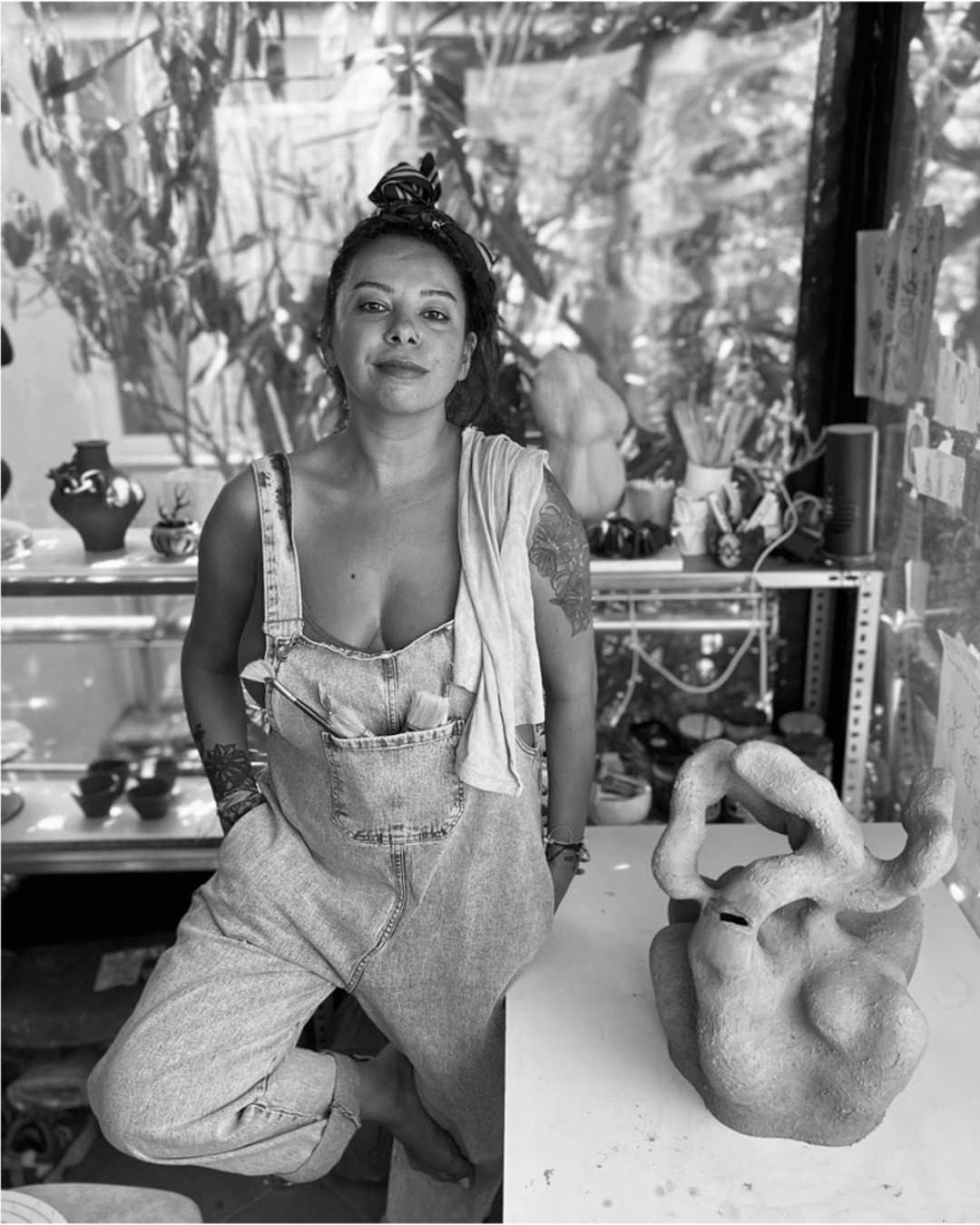
1. Can you tell us a little about yourself?
I was born in Ankara in 1988. I spent part of my childhood in Saudi Arabia. I later returned to Turkey after being accepted into the English Language Teaching program at Dokuz Eylül University. After graduating, I moved to Istanbul and began working in corporate companies, where I held managerial positions for many years. During the pandemic, I decided to relocate to Bodrum. Living in different geographies and cultures has given me a wide range of perspectives and experiences. This accumulation led me to open my own studio in Bodrum, which I felt was the right place at the right time. I continue my work in Bodrum.
2. How did your path cross with ceramics? What is the story behind starting this journey?
Ceramics was not a planned beginning. I worked with various materials for a long time. However, the moment I touched clay, I encountered a different feeling, something more primal and more direct. Over time, this contact became both a way of producing and a way of pausing and feeling.
3. Why did you choose to work specifically with stoneware?
It is a very strong and heavy material, fired at high temperatures. It is both durable and fragile. This tension is what attracts me.
4. Which moment in the production process excites you the most?
Watching the form slowly emerge. While producing, thoughts and designs for the next project begin to take shape, along with the desire to start it as soon as possible. This excitement sustains me.
5. What motivates you the most while working in the studio?
My connection with the outside world diminishes, allowing me to stay within my own rhythm. Sometimes, even if I do nothing, simply being in the studio is enough.
6. What is the most challenging part of doing this work?
Patience, which is not one of my strengths. You wait long hours for the kiln to open without knowing what is inside, whether the piece will emerge broken or cracked, and there is nothing you can intervene in. The process is completely beyond your control. You remain in a constant state of curiosity and excitement. Although this uncertainty is challenging, I believe it is also what keeps me engaged.
7. How do you decide when a piece is finished?
There is no clear criterion. At a certain point, I feel that nothing more is needed. I tell myself not to touch it or add anything, and that is when I say it is finished.
8. What do you do with pieces that do not turn out as you intended or have flaws?
I do not say goodbye immediately. I set some aside and think about what can be done with them, and some I transform. I do not see flawed pieces as failures. I try to understand what happened and carry that understanding into my next project. If I need to let go, I do so and focus on the next one.
9. Where do you usually draw your inspiration from, daily life, nature, people?
From nature itself, but mostly from its details. I am fortunate to live in a village and be closely connected to nature. I can observe almost directly the traces, colors, textures, surfaces, and transformations left by each season. These observations gradually find their way into my work.
10. Are you currently able to make a living from this work?
I think this question needs to be answered in two parts, because earning money from art and sustaining one’s life entirely through art are not the same. Do I earn money from art? Yes. Can I sustain my life entirely through art? No. I believe that art and artists are not sufficiently supported or valued in Turkey. For this reason, until reaching a certain point, it is not easy to make a living solely from artistic production. Therefore, from time to time, without stepping outside my own line, I take on commissioned work to create additional income.
11. How do you think earning money from art affects the production process?
It has a positive effect. Seeing art valued both materially and emotionally gives me hope for the future.
12. How do people’s reactions to your work make you feel?
I feel happy when I hear that what I intended to express has been understood. Their desire to touch the works or spend time looking at them is, of course, pleasing. Critical responses, on the other hand, contribute to my development.
13. What is the most unforgettable feedback you have received so far?
A viewer once said, “Your works are very disturbing.” They meant it not as a negative criticism, but rather as a compliment. It has stayed with me.
14. Is there something you would definitely want to say to someone just starting out?
No matter what, keep going.
15. What are your plans for the future?
I plan to develop projects in disciplines beyond clay. I also want to transform my studio into a living, collective, shared space.