
Tracing the contours of introspection and symbolism, Christophe Correia uses the external world as a vocabulary and symbols as grammar to delve into the depths of consciousness. We discuss the human mind's indelible bond with the cosmos and the quest to reclaim personal freedom through the lenses of darkness and silence.
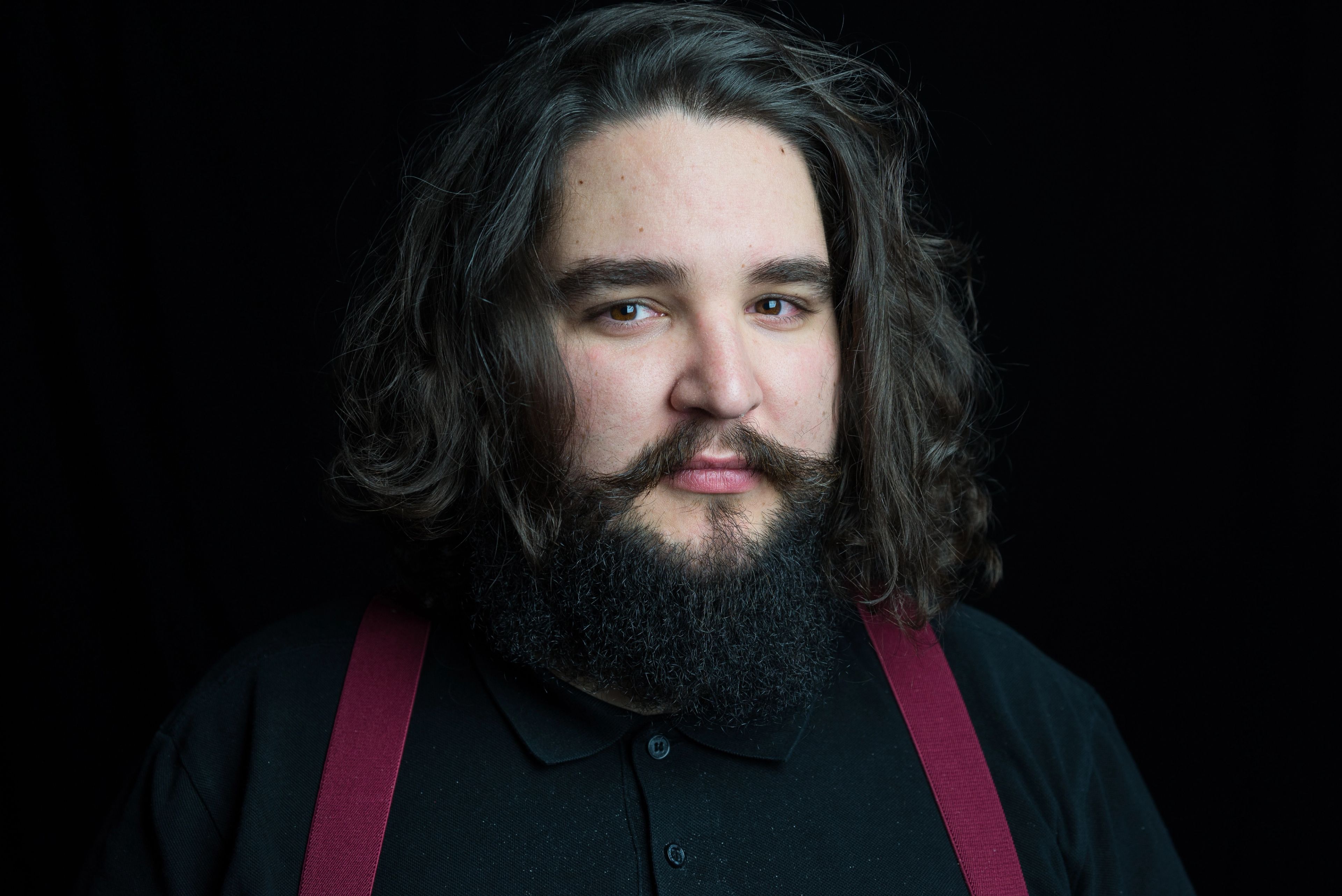
1. Your paintings often feel like inner landscapes rather than depictions of the external world. When did you realize that your artistic language would be rooted in introspection rather than observation?
My introspective artistic language began to take shape during my years in college, especially in moments of boredom and stillness while sitting through classes or during the daily commute between home and school. Looking back, I realize that everything started in those quiet spaces where my mind was free to wander. At that time, I would constantly draw heroes riding dragons, or decaying creatures such as mummies and corpses. Today, I see those drawings as reflections of a transition: the passage from adolescence into young adulthood. They embodied the emotional turbulence of a young man trying to understand himself, feeling as though he didn't quite belong anywhere and fearing he was missing out on life. I have always been something of a loner, and solitude gave me the opportunity to observe and absorb the world around me. I spent time contemplating clouds, nature, flowers, but also the violence inherent in life itself and, at the same time, its profound beauty. Those observations led me to ask fundamental questions: Why can beauty contain ugliness? Why does life inevitably contain death? And conversely, how can death reveal life, or ugliness reveal beauty? As my practice evolved, I realized that observation alone was not enough. If I wanted to communicate these inner reflections, I needed to learn the language of semiotics. The external world became my vocabulary, and symbols became my grammar. I use what I observe not to reproduce reality, but to reveal what I have absorbed from it. Finding the right "universal language" through symbolic imagery has been a lifelong struggle.
2. Many of your works explore the relationship between consciousness, identity, and perception. Do your paintings begin with a philosophical question, a personal experience, or an image that stays with you?
I believe all three are deeply interconnected in my practice. I spend a great deal of time studying philosophy, existential thought, ontology, astrophysics, neuroscience, and science in general. Alongside these, I explore esoteric traditions, alchemy, and the world's major religions and their symbolic systems. But intellectual study is only one part of the process. I also experiment through lived experience: meditation, prayer, fasting, long walks, and allowing myself to be guided by the unknown. I have studied yoga in its broader sense not merely as physical postures, but through its three dimensions: Tantra, Mantra, and Yantra. I have never found altered states induced by drugs to be meaningful. On the contrary, whenever I experimented with substances such as cannabis, I felt more disconnected than connected. For me, the body, nature, silence, and disciplined attention are far more powerful gateways to insight. All of these experiences intellectual, spiritual, and physical feed one another. They allow my mind to establish unexpected connections and generate metaphors capable of communicating what I have learned, and what I am still discovering. Most of my paintings, however, begin with images rather than concepts. When boredom or mental stillness sets in, vivid images seem to project themselves into my mind. Sometimes they arrive while I am working or walking, as if movement itself awakens another mode of thinking. They appear spontaneously, almost like messages emerging from somewhere beyond conscious thought. Occasionally, they feel like answers to philosophical or even ordinary questions I had asked myself days or weeks earlier. What fascinates me is that these answers never arrive as literal explanations. They always come in the form of metaphorical imagery. This has led me to believe that the unconscious communicates with the conscious mind through symbols and metaphors. In many ways, the creative process resembles dreaming but dreaming while awake. Painting then becomes the act of translating those inner visions into a language that others can experience and interpret for themselves.
3. In Speculum Mentis, the eye functions as both a mirror and a portal. What does “seeing” truly mean to you beyond the physical act of vision?
For me, the real question is not what we see, but who is the one who sees? Or, more precisely: Who is the watcher that watches the watcher? It is a question that can lead into an infinite fractal loop of self-awareness. Speculum Mentis is my attempt to represent that paradox: consciousness observing itself. The mirror is essential because I don't believe we discover ourselves in isolation. We come to know ourselves through the reflections that the external world produces within us. Every encounter with another person, every conflict, every emotion, becomes a mirror revealing something that was already present but hidden. Questions such as Why does this person make me so angry? Why does this situation hurt me so deeply? Why do I believe this is so important? Why am I drawn to this? are, to me, far more valuable than the immediate answers. I often say that the secrets of the self are found within the questions as much as within the answers. Genuine self-knowledge begins when we become curious about our own reactions. This idea resonates with Lacan's statement that "desire is the desire of the Other." He suggests that we come to know ourselves through what appears to be missing, through the way desire is structured in relation to others. My own experience through meditation has led me to a slightly different, though complementary, intuition. What we experience as lack may also point toward something that already exists within us in potential, something waiting to be uncovered rather than acquired. In that sense, seeing is much more than the physical act of vision. It is the capacity to witness the movements of one's own consciousness. The eye in Speculum Mentis is therefore both a mirror and a portal: a mirror because it reflects the self through the world, and a portal because every sincere act of observation opens the possibility of a deeper encounter with who we are.
4. Your compositions combine cosmic imagery with deeply personal symbolism. Why do you think the universe is such a powerful metaphor for the human mind?
Because no one truly understands what the universe is let alone the universe that exists within each of us. I see the mind, the spirit, and the body as three dimensions that together shape the Self. To explain this metaphor, I often think of two lines from the Tabula Smaragdina: "That which is above is like that which is below, and that which is below is like that which is above." They express the idea that the human being and the cosmos mirror one another. We tend to believe we are separate from the universe, but I see that separation as an illusion. My perspective is closer to Spinoza's Deus sive Natura God, or Nature. We are not outside the universe; we are expressions of it. In the end, each of us is an infinite drop within the Infinite.
5. “Lux in Tenebris” suggests that darkness is not something to escape but something to move through. How has your own understanding of darkness changed over the years?
I believe it is a journey that many people go through while discovering their true selves. At first, we fear and reject the darkest parts of ourselves. Then comes the struggle the attempt to fight or suppress them. With time, I came to understand that these darker aspects are not enemies. They are parts of us that were trying to protect us from pain, from uncertainty, and from the unknown. “Lux in Tenebris” reflects that realization. Darkness is not a place to escape, but a place to move through. When we stop resisting it, we often discover a quiet inner light that has always been there, waiting to be uncovered.
6. Your work invites viewers to confront themselves. Has creating these paintings ever revealed something about yourself that you weren’t expecting?
My paintings are, in many ways, a reflection of who I am and what I have learned. They embody my beliefs, my questions, and my experiences, expressed through metaphorical keys rather than direct answers. I don't seek to tell viewers what to think. Instead, I hope my work encourages contemplation and helps reveal a door that only they can choose to open within themselves. And, of course, I sometimes do this through provocation and discomfort. I believe that what unsettles us often reveals more about ourselves than what merely comforts us.
7. “Dominus Clavium” speaks about reclaiming the keys to one’s own life. What inspired this metaphor, and do you think people are becoming more aware of the invisible ways they surrender their freedom?
“Dominus Clavium” was inspired by the idea that the most important keys we possess are not those that open doors in the external world, but those that allow us to govern ourselves. I would like to believe that people are becoming more aware of the invisible ways they surrender their freedom. However, I often see the opposite. Public debate has become increasingly polarized, and many people define themselves through rigid ideological identities. To me, this can make genuine dialogue and independent thinking more difficult. Social media has played a complex role in this. It has the power both to expand our perspective and to narrow it. It can expose us to knowledge and diverse ideas, but it can also trap us in narratives, algorithms, and confirmation bias. That is why I believe it is essential to question not only the messages we receive, but also who benefits from them and why they resonate with us. Ultimately, Dominus Clavium is not about politics it is about responsibility. It asks whether we are consciously holding the keys to our own lives, or whether we have unknowingly handed them over to fear, ideology, or external influences. The painting is an invitation to reclaim those keys through self-awareness rather than certainty.
8. The recurring eye in your paintings appears almost like a silent witness. Is it the viewer’s eye, your own, or something beyond both?
To me, it is the Watcher the silent witness behind thought itself. The dreamer of dreams, the presence that gives rise to the conscious self. I don't claim to know what it truly is. Perhaps it is simply a metaphor for consciousness, or perhaps it is something beyond our understanding. What interests me is that we can sometimes sense it when we become completely still and allow the body and mind to move without force. One practice I often recommend is what I call automatic walking: walking without a destination, allowing intuition rather than intention to guide you. Only afterwards do you realize why you needed that journey. The recurring eye in my paintings is therefore neither mine nor the viewer's. It represents that silent witness which, in one way or another, exists within us all.
9. “Silence” seems to play an important role in your practice, especially in works connected to Regnum Silentii. What does silence offer that words cannot?
In silence, you can find your true voice. You can hear the whispers of the Watcher. You can see the images that crystallize in your mind and become aware of the subtle ways emotions move through your body. Regnum Silentii explores these ideas. It is about the struggle to attain a meditative state the silence of the mind, the stillness of body and consciousness, and the knowledge that emerges when we stop resisting our darkest parts. It is about learning to observe the Watcher and becoming receptive to the realm of dreams and the unconscious. In a way, painting belongs to this silence. Light itself is silent; it speaks through color, form, value, and empty space. Perhaps only those with a kind of synesthesia can truly "hear" color, but I believe every painting has its own silent voice it simply asks the viewer to listen differently.
10. You work primarily with oil paint, a medium known for its patience and depth. How does the physical process of painting influence your emotional and conceptual journey?
As a product designer by training, I have always paid close attention to the materials I use. I am still learning, but I always try to choose the highest-quality archival materials available, and oil paint is one of those choices because of its permanence and depth. Today, I use high-quality handmade oil paints from DarteCor, the only producer of master- and restoration-grade oil paints in Portugal. Over time, I have also developed a painting medium that allows me to work much faster than many people expect with oils. I always respect the fat-over-lean principle, but my process is flexible enough that I rarely have to wait long before applying the next layer. The waiting time between layers is just as important as the painting itself. It gives me the opportunity to step back, study the work, and plan my next move. Painting often feels like a game of chess: every decision influences the next, and even mistakes become opportunities that shape the final composition.
11. Growing up between France and Portugal, surrounded by traditions, music, and folklore, how have these cultural influences found their way into your visual language even indirectly?
I think these influences are present more in my values than in my imagery. I had the chance to grow up between the countryside and the city, which gave me both a deep connection to nature and an openness to different cultures. I grew up listening to traditional folk music as much as deep, dark techno. I have never been able to see life superficially. Growing up in the countryside taught me very early that life and death are inseparable. When you learn that the food on your table must first be grown, harvested, or even killed, you quickly understand both the beauty and the cruelty of existence. It is a difficult lesson at first, but it teaches respect for all forms of life. That perspective naturally found its way into my paintings. I try to place every living being on the same level because, in the end, we are all simply trying to exist. The bagpipes, drums, and traditional folk music of northern Portugal also left a deep impression on me. Their rhythms carry something ancient and primal they remind me of humanity's enduring struggle to live, endure, and belong.
12. Your paintings balance realism with symbolism. How do you decide when an idea should remain recognizable and when it should become metaphorical?
I don't really see realism and symbolism as opposites. Realism is the language that allows the metaphor to become believable. The viewer first recognizes something familiar, and only then begins to question what it means. I use realism to invite the viewer into the painting, and symbolism to take them beyond what they initially see. Realism helps the viewer recognize the image. Symbolism invites them to discover what lies beyond it. My goal is to create a painting that can be read on both levels at the same time.
13. If someone stood in front of one of your paintings for an hour without reading its title or description, what do you hope they would experience?
I hope they would experience something similar to what I felt standing before Harrison's Solitude at the Musée d'Orsay, Ribera's Saint Paul the Hermit at the Louvre, or while visiting Dalí's Theatre-Museum, his house in Portlligat, and the Dalí Castle in Púbol. More than understanding the painting, I hope they would enter into a silent dialogue with it a deep communion through metaphor and symbolism. If I had to summarize that experience in one word, it would be poetry: a feeling of recognition, contemplation, and, ultimately, belonging.
14. Looking ahead, what questions are you currently trying to answer through your work, and where do you see your artistic journey leading next?
For now, my main objective is to complete Regnum Silentii, a series of 25 paintings and drawings by the end of this year. Beyond that, I have already conceived a larger project: a collection of 150 paintings built around a single overarching theme, which I prefer to keep secret for now. It will unfold through six series of 25 works, like chapters of one book. Looking even further ahead, my ambition goes beyond painting. One day, I would like to create a contemplative space where people can reconnect with themselves a place where art, architecture, and silence come together to foster peace, reflection, and inner stillness.