
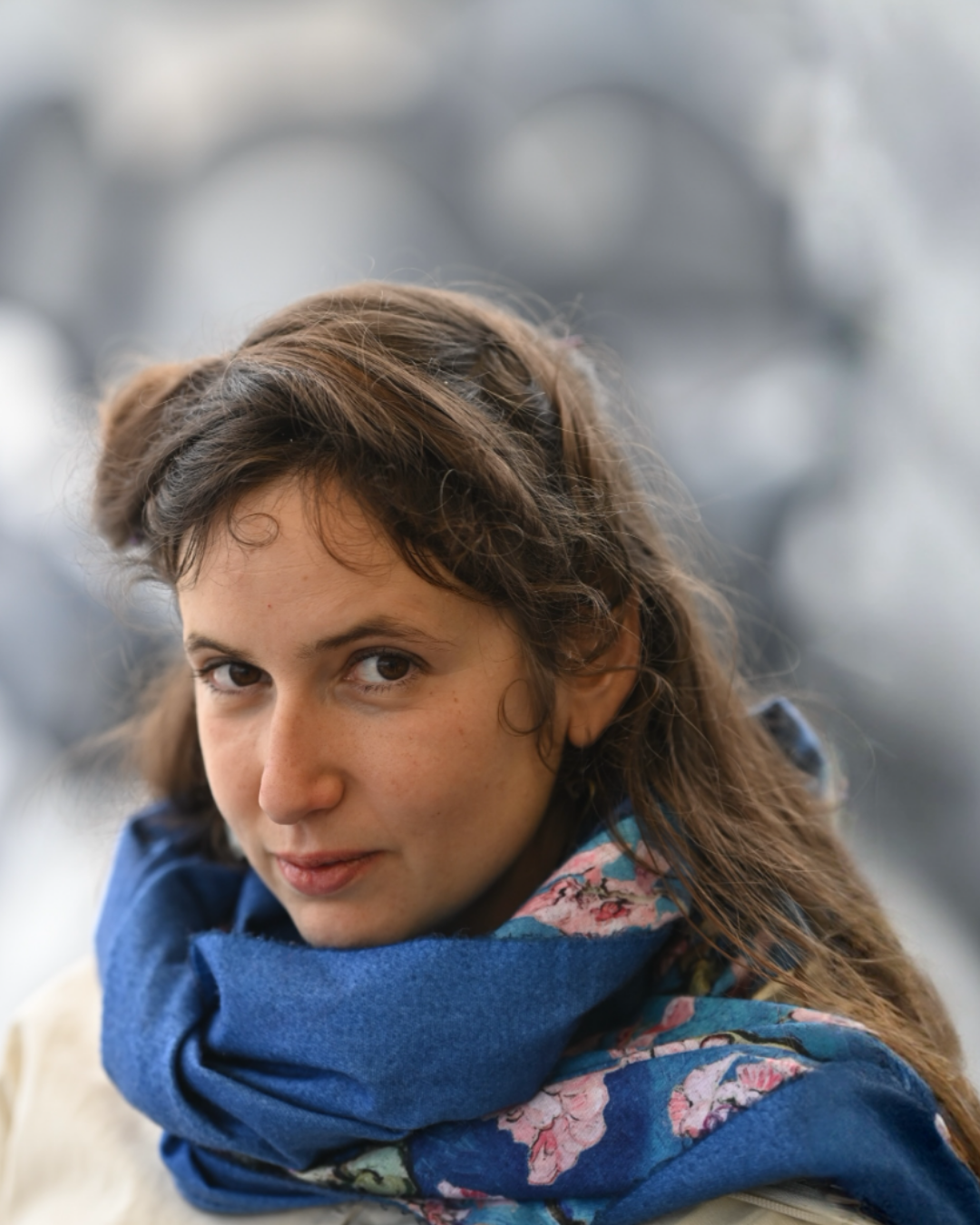
Multidisciplinary artist Mina Kocailik reflects on making room for uncertainty, the intersection of poetry and image, and her intuitive practice rooted in personal transformation.
1. You describe art as a “search for meaning.” What does this search mean to you today?
Looking at the world with curiosity, researching, imagining, going deeper, looking beneath the surface, creating a language, pushing boundaries, making connections... Ultimately, it means existing, being present, being alive.
2. You say that you make room for uncertainty while painting. What does working with uncertainty bring you?
Excitement. Curiosity. Mystery. Trust. Confidence. Playfulness, anger... Chaos, catharsis, tracing the unconscious, emotional depth... Escaping the mind, losing track of time, becoming one with the painting... Originality, freedom, authenticity... I also experience art-making as a spiritual practice.
3. How much of your process is planned, and how much do you leave to improvisation?
In the beginning, I worked entirely through improvisation, back when I was painting only for myself. As I became a professional artist, things gradually changed. As my practice deepened and became more established, I developed certain essentials. For example, I now strive to incorporate words or sentences into every painting and create a poetic language. Depending on the project, the theme is often determined beforehand. I usually define and limit my color palette in advance, and I identify certain images or symbols as a starting point for the composition. Sometimes I make sketches, but once I begin, I allow those images to transform completely, and they usually do. So while the composition is largely improvised, I become more intentional later in the process, refining the work. In short, I plan the framework, improvise within it, and finish the work through a more structured approach.
4. Is there a particular reason why you combine acrylic and collage in your work? How do you see the relationship between these two techniques?
I'm constantly searching for new possibilities. At the moment, these are the two mediums I work with, but I may incorporate others in the future. Collage offers endless possibilities and reconnects me with a childlike sense of creativity. Acrylic often serves to strengthen the effect of the collage; I use it as a complementary medium. Sometimes I work exclusively with acrylic, and other times only with collage.
5. The vibrant colors and patterns in your work are striking. What do they represent for you emotionally or conceptually?
They represent freedom. In a world that increasingly feels grey, black and white, sterile, and surrounded by concrete, vivid colors express a need for vitality, originality, and freedom. Through layered compositions and intricate colorful patterns, I intentionally create chaos. I understand that this can feel overwhelming to some viewers, but I don't expect myself to pretend chaos doesn't exist. Perhaps this is also how I express anger.
6. Rather than reproducing reality, you seem to prioritize imagination. What can imagination tell us about reality?
Imagination simply tells me how awful reality is. What else could it say? It shifts the focus from the outside world to the inner one. It emphasizes individuality and originality, giving creative practice tremendous strength. In that sense, imagination is inherently oppositional and subversive.
7. What role do naïve figures and abstract elements play in your work?
Abstraction forms the foundation of my practice. At the same time, I want to connect with viewers and be understood. That's why I try to offer points of connection within abstraction, sometimes through a figure, sometimes through words or textual references. I consider my figures childlike and naïve. Partly because I never received formal academic training in painting, and partly because I'm not interested in confining myself within established rules or conventions. Since I'm not concerned with depicting reality as it appears, this may also be how I express the more rebellious side of myself.
8. How do poetry and writing nourish your visual practice? Which usually comes first: words or images?
They are essential to my practice. I wrote poems for most of my paintings because, while working abstractly, I felt a strong need to connect. I exhibited my paintings alongside their poems. That same desire for connection eventually led me to incorporate words, poems, and fragments of text directly into the paintings themselves. I'm still exploring this relationship. Usually, the images come first and the words complete them. But the opposite has happened too. I have created mixed-media works inspired by my own poems. At the moment, I feel I'm in a period of gathering and maturing, collecting words. I can imagine myself creating a book one day, combining words and images.
9. How does your interest in psychology, mythology, and esotericism find its way into your art?
Psychology, mythology, and esotericism all relate to the collective unconscious. I paint the inner world, emotion, presence, and the soul, and I use symbols emerging from the collective unconscious. These interests naturally bring a more mythical and naïve quality to my work. I'm also a tarot reader. To maintain discipline in my practice, I ritualize my routines, for example, by drawing a tarot card before I begin working. Inevitably, these symbols and spiritual sensitivities find their way into my work. I've also noticed that animal figures appear more frequently in my paintings without conscious planning, and I believe they, too, emerge from the collective unconscious.
10. Stories of transformation seem to occupy an important place in your practice. What draws you to this theme?
My own story. I studied law and built a life around it before experiencing a profound turning point. I made a complete U-turn because I could no longer tolerate certain realities. I reconnected with the essence I carried from my family, childhood, and artistic identity. It was a difficult transition, with sexual, psychological, and mental consequences that are still unfolding. That's why I'm deeply drawn to stories of transformation and feel a deep sensitivity toward them.
11. In what ways does feminist thought influence your work?
Simply existing as an independent woman artist in a male-dominated world, and I include the ego-driven structures of the art world in that, is already a feminist act, regardless of the content of my work. I consider myself a feminist, although I'm not particularly attached to labels. I'm not driven by theory. Instead, I follow the impulses, needs, desires, and emotions that arise from within me. That inner listening first led me to explore themes of sexuality in my work because I felt a strong need for expression. Later, my practice evolved into different themes, yet I realized that female figures continued to appear naturally, not by conscious decision, but as reflections of my unconscious and my identity. At one point, I wondered how I could make explicitly feminist work, but eventually I realized that my very way of being and creating is already feminist. I see it reflected in my improvisational method, the rounded forms of my figures, my color palette, my naïve lines, and my poetic curiosity. At the moment, I'm collaborating with two fellow artists on the TABU Project. Together, we're collecting material through participatory circle practices around the concept of taboo and developing a group exhibition. We began by exploring themes such as sexuality and the visibility of emotions. I, for instance, see the creation of artistic practices based on inclusivity and deep listening as inherently feminist.
12. What differences have you observed between creating work on the street and working in a studio environment?
In 2018–19, while traveling in India, I created art on the streets and sold small works. Studio practice allows me to create larger-scale paintings, whereas street work naturally required smaller, portable pieces. That period was my starting point. I wasn't taking myself too seriously. I was simply experimenting with freedom. I was nourished by people's glances and reactions. Today, I enjoy working in a studio, meeting myself in the same place at the same time.
13. How have places such as Istanbul and Kayaköy influenced your artistic process?
In 2020, I moved to Fethiye and settled in Kayaköy. I lived there in relative isolation, away from society, which helped me develop my artistic practice and understand what I truly wanted. It gave me clarity about where to direct my focus and how I wanted to shape my life. Looking back, I see those years as an important foundation. After becoming more confident in my decisions, I realized I wanted to reconnect with a broader artistic community. Five years later, I returned to Istanbul. Here, I visit more exhibitions, encounter more artistic practices, collaborate with other artists, and think more critically about where my own work fits within a larger context. I'm nourished much more by external dialogue now. I think it's about different needs at different stages. Sometimes I need solitude; at other times, I need to return to the world. And when I step back into it, I know who I am. That's incredibly valuable.
14. What do you hope viewers feel or question when they encounter your work?
I hope people pause, look closely, remain in uncertainty for a while, think, and allow themselves to experience multiple meanings and emotions. I want them to step outside rigid patterns of thought: “X is Y.” “This is how it is.” “That’s how it is.” I hope they can let go of those certainties. How can a person, without getting stuck in predetermined rules, develop a personal language in a stable, original, free, and courageous way, guided only by an inner compass? Within this framework, I hope a consistent discipline can be observed.
15. What creative question excites you the most today, and where might it lead your future work?
How can a painting become poetic? This is something I’m deeply curious about. I’ve only recently started exploring this question, and I still feel there isn’t enough written on the subject, so it’s a journey I intend to continue. I’m interested in both painting and poetry, and rather than treating them as separate disciplines, I keep asking myself how they might merge. How can an image function like a poem? How can poetry emerge through visual language? I wonder whether these questions might eventually lead me toward works that are more mystical, ambiguous, symbolic, and perhaps even surreal. These are the ideas I find myself thinking about lately.