
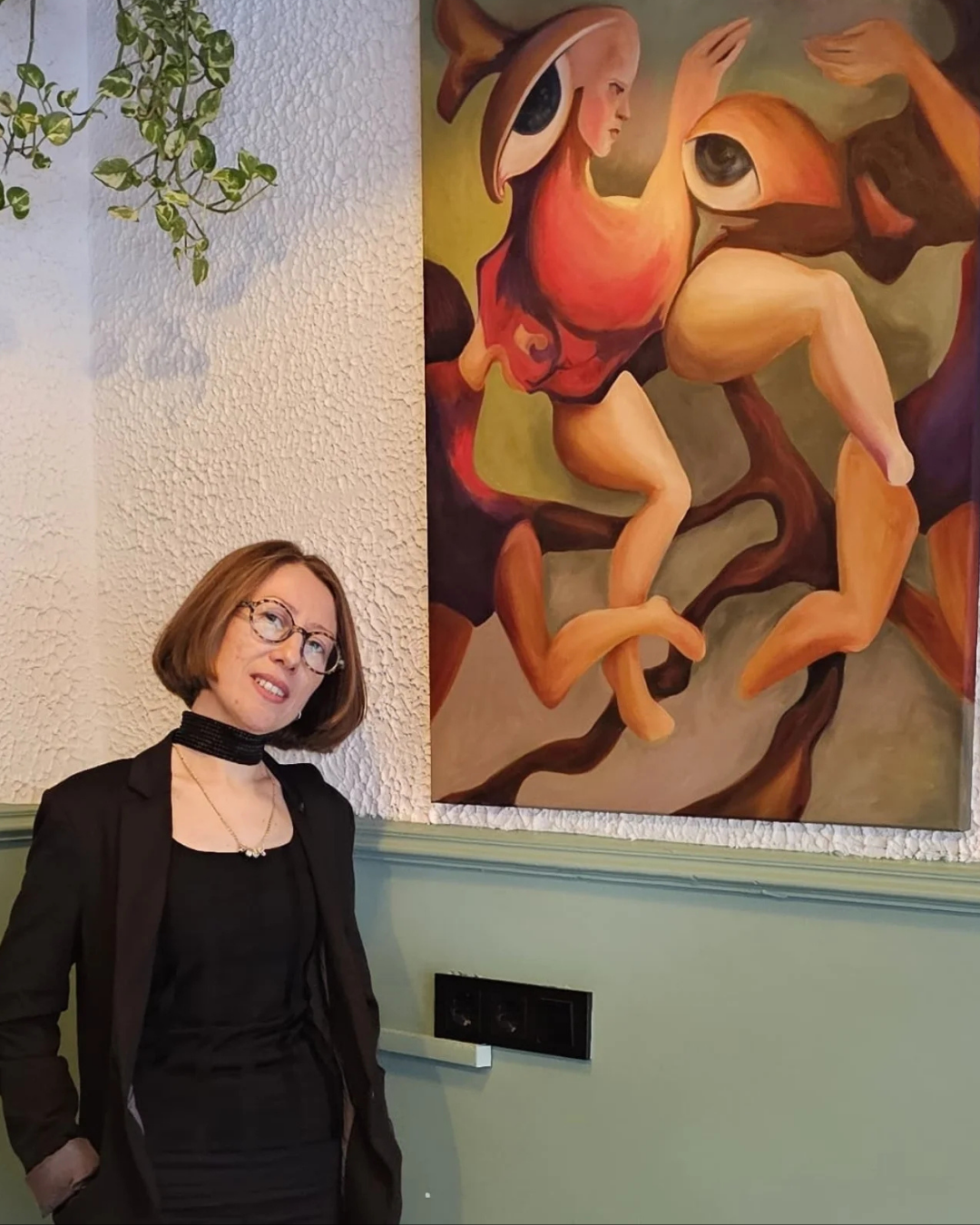
Translating existential inquiries, overlooked daily nuances, and the subconscious layers of dreams onto the canvas,Ebru Sıcakyüz interrogates formal and psychological boundaries. Bridging a visual memory shaped by textile design with the liberation of painting, this conversation invites the viewer to gaze into the reflections of a broken mirror.
1. Existential questioning occupies an important place in your artistic practice. What was the starting point of this inquiry for you?
Ever since I can remember, questions such as "What should I live for?" and "Why do I have to survive?" have always been with me. While the people around me seemed to possess a natural motivation for living, my mind was constantly filled with questions. The contradictions between everyday life and grand narratives, the inequalities I witnessed, and the inconsistency between traditional rules and reality all fueled my curiosity. In short, these persistent questions and inner conflicts became the starting point of my journey toward understanding myself.
2. Many details that people overlook in daily life seem to nourish your creative process. How do you know when a detail will eventually become an artwork?
I think every artist is, in a way, compelled to become obsessively focused on certain details, not because they choose to, but because they cannot do otherwise. Before beginning a work, I first immerse myself in life as an active participant, drawing inspiration from various sources until I feel it is time to turn inward. This inward retreat, these quiet periods of withdrawal, repeat themselves like a cycle. Then I simply surrender my mind to the lines of my sketches.
3. Fragmented figures and incomplete bodies frequently appear in your works. What do they represent?
I see fragmented figures as a reflection of the way I perceive the world. Although the physical world appears complete, the reality our minds construct through perception resembles a broken mirror. The ideas that accompany us throughout life may seem coherent, yet none of them is ever entirely logical or absolutely true. Our judgments constantly deceive us.
4. The unconscious and dreams are among the main sources of your work. Have you ever had a dream that directly inspired a piece?
There is not one specific dream that directly inspired a work, but I do have recurring dreams. Rather than reproducing a particular dream, I prefer to create dreamlike compositions using imagery that resonates with me. In this way, even without a clear narrative, I hope each viewer experiences something different emotionally.
5. How does Jung's concept of archetypes influence your creative process? Which archetype do you feel closest to?
My work did not begin with Jung, but as I immersed myself in his ideas, I realized that they strongly resonated with the inner universe I had already been building. This gave a deeper foundation to my artistic ideas. Just as with my dreams, I do not focus on a single archetype. Instead, I allow what I learn and feel to grow naturally within my own aesthetic language.
6. You explore symbols in both their personal and collective meanings. Has there ever been a symbol whose meaning completely changed for you over time?
No, there has not. However, through this process I discovered that any image carrying significance for me can be anchored to a specific emotion or memory within my unconscious and psychological landscape. Even thinking about the historical evolution of something as ordinary as an emoji, or the transformation of languages over time, continues to fascinate me.
7. How has your background in textile design influenced the composition, texture, or color in your paintings?
At first, I believed it had not influenced me. But I do not think it is possible for someone whose eyes have long been immersed in patterns, colors, and textures to completely detach from that visual memory. Design keeps one's aesthetic perception alive, and I see that as a valuable foundation. Still, working with paint excites me far more than working with fabric ever did.
8. How do you balance the discipline of design with the freedom of artistic creation?
Design and art are completely different languages. Although working within the limitations and demands of design may sometimes seem easier, each discipline has its own unique dynamics. Art, on the other hand, feels like speaking in another language, one that is freer and ultimately more fulfilling.
9. Does it bother you if viewers cannot immediately understand your work, or do you see that as part of the experience?
It does not bother me at all. Because art literacy has not been properly cultivated, many people mistakenly believe they do not understand art. Yet simply being captivated by colors or experiencing aesthetic pleasure is often enough. In today's world, where we are constantly surrounded by images, it is impossible not to have some form of visual sensibility. Unfortunately, grand narratives and overly authoritative interpretations have made people afraid of art.
10. Your works create an ambiguous space between reality and dreams. Do you think these two worlds can truly be separated?
I believe they are both part of life. While we exist within a universe governed by the laws of physics, our unconscious accompanies us, helping us perceive, cope with, and create our own interpretations of reality.
11. What do you think is the greatest turning point in the relationship people have with themselves in today's world?
There are many reasons for this. It is easy to blame social media or technology, but these fractures have existed throughout history. I believe the greatest responsibility lies with the systems and structures imposed upon us. In a world where some people are granted more equality than others, individuals are consciously deprived of opportunities for genuine self-discovery.
12. Which image or symbol you use in your work represents you best, and why?
I would not say any single image represents me best. Most of the time, they seem to find their own place naturally. Even so, despite the abundance of kitsch associations surrounding them, I love painting eyes. Sometimes I deliberately paint them precisely because they risk appearing kitsch. Eyes have carried different meanings across every historical period and cultural context.
13. When creating art, are you guided more by intuition or by a preconceived idea?
The most satisfying results come when the two work together. My personality naturally gravitates toward planning and conceptual preparation, but throughout the process I also embrace the unpredictability of the unconscious and the role of chance.
14. Your spouse is a seafarer and spends long periods at sea. Has this influenced your perspective on concepts such as time, longing, waiting, or solitude? Do you think this experience is reflected in your work?
I accompanied my spouse on many of those voyages. I believe these journeys had a profoundly positive influence on the way I see life. Beyond witnessing the vastness, and at the same time the smallness, of the world and encountering different cultures at a relatively young age, I was introduced to a profession I had never known and experienced an environment that very few people have the opportunity to witness. It expanded the conceptual landscape of my mind. Maritime terminology, much like the language of textiles, seemed to open entirely new rooms within my imagination. It felt as though my native language itself had deepened. I found this new vocabulary deeply fascinating. It encouraged me to write more and awakened an even stronger desire to express myself. Of course, during the periods when my spouse sailed alone, that sense of longing inevitably found its way onto my canvases.
15. What feeling or question would you most like viewers to take with them after experiencing your work?
A feeling. Whether it is fear, unease, or peace, whatever it may be, I hope they leave carrying an emotion.
16. What advice would you give to those who are just beginning their journey in art?
Without worrying about whether what they are making qualifies as "art," they should simply keep drawing, working, and creating. Above all, they should strive to remain authentic.