
In his studio in Diyarbakır, Eren Kara juxtaposes sunflowers against the mechanical harshness of concrete, ruin, and heavy machinery. Positioning art as a confrontation rather than an escape, he explores the conceptual tension between urbanization and nature.
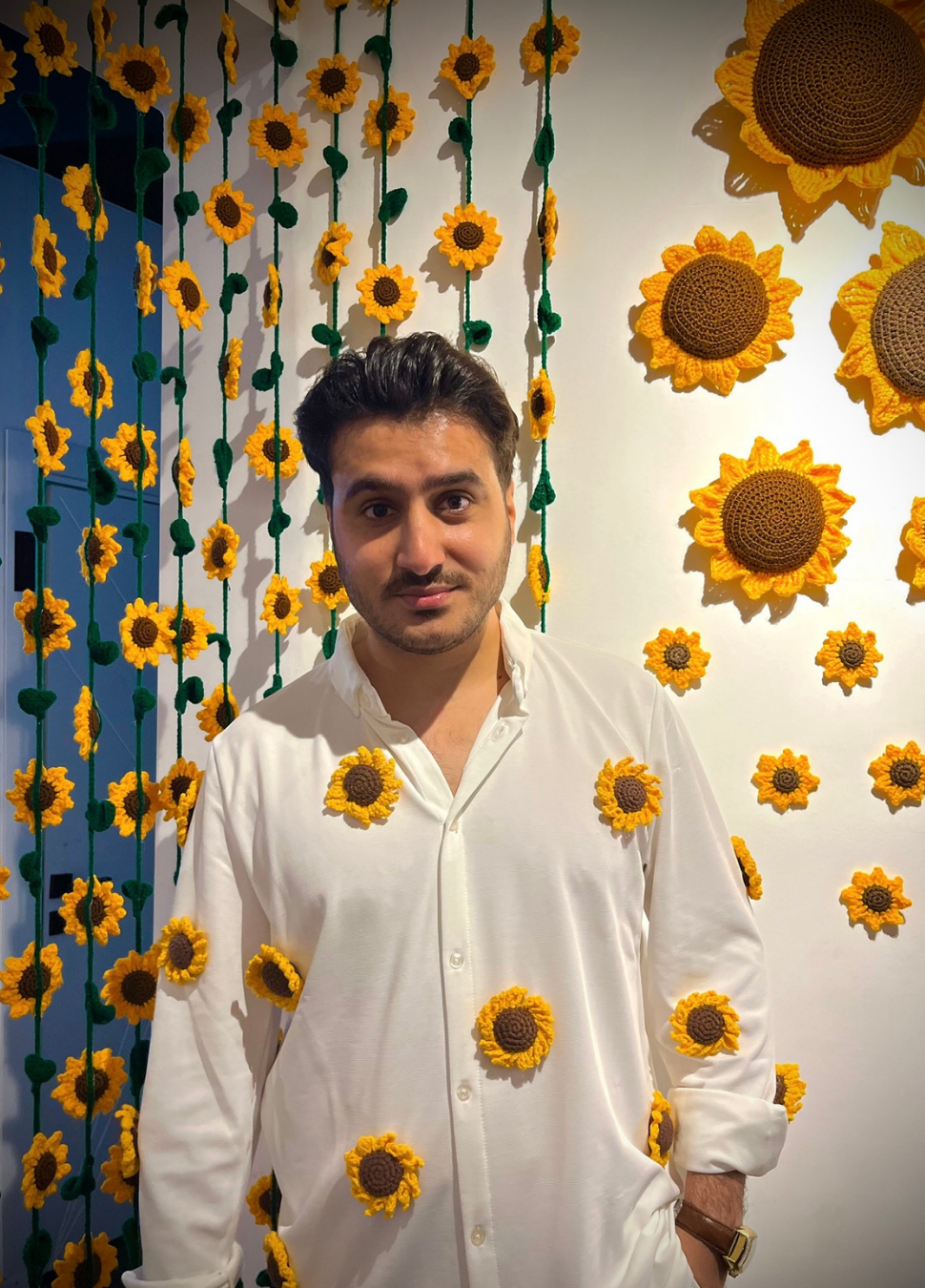
1- Could you briefly tell us a bit about yourself?
I was born in 1995 in Diyarbakır, Turkey, and I continue my artistic practice in my studio. My work often revolves around nature, humanity, the environment, concrete, destruction, and construction machinery. By juxtaposing these harsh and mechanical images with sunflowers, I aim to emphasize nature's resilience, hope, and the regenerative power of life.
2- Is art an escape route for you or more of a form of expression?
For me, art is never an escape; on the contrary, it is a form of confrontation. It is a space where I try to rediscover myself, humanity, and nature amid the chaos, destruction, and silence of the world. Art is an expression of inner resistance and existence. Creating allows me to reconnect with both what I see and what I feel. Instead of running away, I choose to stay at the very center of that emotion and transform it.
3- Have you ever had a piece that you felt was never truly finished? Or what should a "completed" artwork be like?
I can never say that any of my works are ever truly "finished." Each piece reflects the state of a feeling or idea at a particular moment; as I change over time, so do my works. I believe there is no such thing as a completed artwork, only a creation that has said what it needed to say at that moment. In art, there is no ending, only transformation.
4- Was there someone in the past who inspired you? Perhaps a friend, a teacher, family, etc.?
My interest in art and my ability to paint have been with me since childhood. My family has always supported me in this regard. When I established my studio to create and build my own artistic space, one of the books that inspired me most was The Way of the Bow by Paulo Coelho. This book reminded me that creating is not a goal, but a journey.
5- Do you prefer to be alone when creating your art?
Solitude is not a necessity in my creative process, but rather a need. In those moments, I can establish a deeper connection with myself and with the nature, people, and environments I depict. Silence allows thoughts to take shape and emotions to transform into painting. However, this solitude is not a complete detachment; the sounds of the outside world, the events, and the things I witness take on new forms within that silence. So, even though I may appear alone, there is always a resisting sense of life and hope within my paintings.
6- Has any period in your life brought a new perspective to your artistic view? For instance, a relationship or a journey?
Sunflowers have always appeared in my paintings; however, the February 6th earthquake and the modern world's ongoing destruction and concretization of nature brought a new subject matter and perspective to my work. These events not only provided a visual theme but also added an intellectual dimension that questions humanity's relationship with nature.
7- Has there been a movie or a book recently that influenced you? Have you thought about how it impacted your art?
Two books that have recently influenced me are The Way of the Bow by Paulo Coelho and Animal Farm by George Orwell. The Way of the Bow shows that creation is not a fixed goal but a continuously unfolding journey, emphasizing the importance of belief and perseverance in reaching one's aim. Animal Farm prompted me to question power, equality, and oppression, and to reflect on the injustices within society and people's tendencies to control one another. These experiences added new layers of depth to the themes and perspectives in my work.
8- What was the strangest thing you learned about painting?
Sometimes the most unexpected objects acquire entirely new meanings as they transform into paintings. Mechanical elements such as concrete or construction machines can generate different narratives within my works; even designing figures with sunflower heads brings a sense of renewed life to my compositions.
9- Did you have a turning point or an "Aha!" moment while making your art? Can you tell us how transformative that moment was?
This actually happened quite recently. I research and read new things every day first designing my ideas digitally before transferring them onto canvas. During this process, certain images and figures gradually evolve and gain new meanings. For instance, placing sunflowers on the faces of my figures created a new narrative depth and introduced a transformative dimension to my practice.
10- Do the colors, shapes, or techniques you use in your art reflect an impression or emotion from your personal life?
Some of the colors and techniques I use reflect my personal emotions and impressions. The natural yellow and orange tones of the sunflower express hope and resilience, while shades of black and gray convey the harsh and mechanical aspects of the modern world that I observe.
11- Have you ever said that you love the process more than the results? How much does that feeling of getting "lost" while creating belong to you?
Yes, for me, the process matters much more than the result. During that process, I establish a connection both with myself and with what I create. At times, there is also a sense of being lost, yet this feeling is a natural part of creation. That state of uncertainty pushes me to explore new paths and to rethink the painting itself. Even though the result may eventually become visible, what truly matters is the process, where I re-interpret both myself and the world.
12- Does an inner voice guide you while creating your art?
Most of the time, an inner voice guides me. This voice can take the form of questioning, silence, or simply a feeling triggered by an image. Listening to it is the most natural part of my creative process because that is when I most clearly understand what drives me and which emotion leads my actions. I always carry within me a sense of hope that good things will come, and I believe that voice often originates from that very hope.
13- In your opinion, what do people usually feel when examining your art?
I can never truly know what others feel that will always remain a mystery to me. But I hope that those who view my works can sense at least some of what I feel, especially hope, resilience, and the fragile yet persistent side of life. Just as a sunflower never stops turning toward the sun, I wish for the viewer to recognize that same act of seeking light, that same determination to hold onto life.
14- Top 3 favorite pieces of music
Nessi Gomes - All Related Tom Odell - Another Love Salif Keita - Folon
15- Top 3 favorite books
Paulo Coelho - The Way of the Bow George Orwell - Animal Farm Franz Kafka - The Metamorphosis
16- Top 3 favorite foods
Turkish stuffed eggplants (Karnıyarık / İmam Bayıldı) Sautéed meat Boiled chicken
17- Top 3 favorite activities
Hiking in nature Exploring new cities Playing football
18- Top 3 favorite cities
Amsterdam Paris Istanbul
19- Is there money in art?
I am never financially driven in my artistic practice; however, considering the materials, techniques, and spatial conditions involved in art production, money inevitably becomes a necessity. In my view, earning a living through art is closely tied to the city, country, and geography in which the artist lives. In places that value art and support creative production, artists can sustain their practice more easily; unfortunately, this is not possible everywhere.
20- What are your recommendations for beginners?
What I would most like to tell those who are just beginning their artistic journey is to trust the process. Art does not emerge through haste; it is shaped through experimentation, failure, and reflection. It is perfectly natural not to know exactly what you want to do at the beginning, or to lose your direction from time to time that, too, is part of creation. Reading, observing, and nourishing oneself are essential, but above all, one must have the courage to find their own voice. Instead of trying to resemble others, one should carve their own path. The essence of art lies in that unique relationship a person builds with themselves and with the world.