
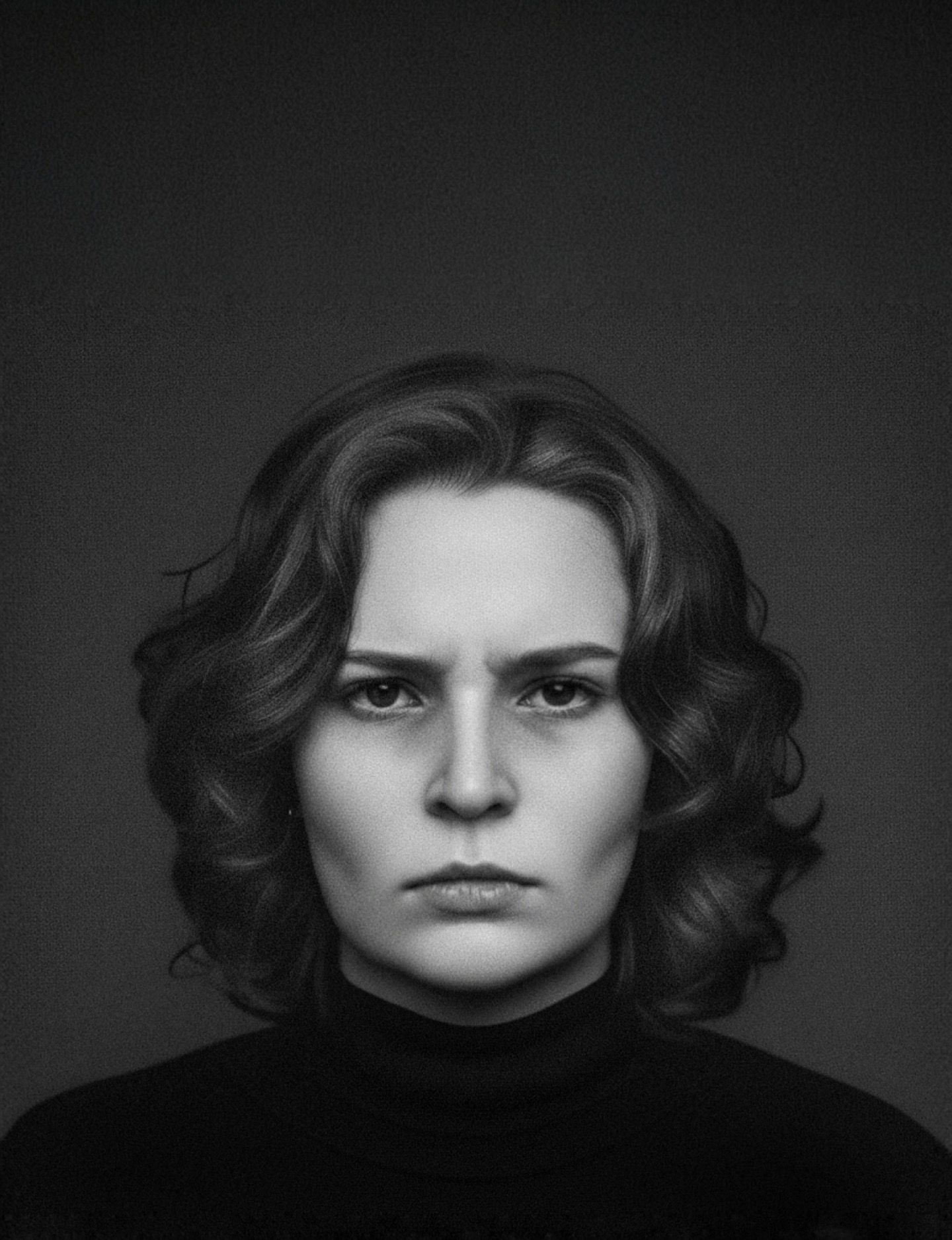
Investigating AI, 3D, and the perception of the digital image through her series Human Creations, Alara Başar joins Flaneuse Magazine. Spanning the transition from traditional painting to the fluidity of new media, this conversation unpacks the sense of incompleteness in art, the search for mental order behind sterile white rooms, and the uncanny tension awakened in the viewer.
1. Could you briefly tell us about yourself?
I am Alara, born in Sakarya in 1998. I graduated from the Graphic Design and Photography department in high school. I completed my Bachelor's and Master's degrees in the Painting Department at Duzce University. Currently, I am producing works centered around New Media.
2. How would you define your style? (Artistically)
In my previous artistic productions, I created works focused on painting and photography. Recently, I have been using computer technologies (3D, Artificial Intelligence, etc.) to produce photography and video works.
3. Is art a way of escape or more of a form of expression?
I think this depends entirely on the individual; if someone is creating to escape from something, it can be a way of escape. But that, in itself, is already a form of expression.
4. Have you ever had a work that you felt was never completed? Or, how should a "completed" piece of art be?
During my transition period to new media art, some of my works felt unfinished, but this wasn't an "incompleteness" in terms of text or expression; it was purely technical. By developing this technique on my own, I am now able to complete those previous incompletenesses.
5. Was there anyone who inspired you in the past? Perhaps a friend, a teacher, family, etc.?
There were people in the past, and there still are. I prefer not to mention a single name, as it might be unfair to others from whom I have unconsciously drawn inspiration. I can find inspiration in many things.
6. Do you prefer to be alone while creating your art?
Most of the time, I prefer to be alone while producing. This applies to many things in life; sometimes I do enjoy working within a crowd, but that is entirely something I do to reset myself. I am much more comfortable when working alone.
7. Has any particular period in your life brought a new perspective to your artistic outlook? For instance, a relationship or a journey?
A past period that I thought I had closed down actually plays a massive role in my current productions. A very brief moment can bring a new perspective, and so can something you thought you buried a long time ago. I cannot diminish this by categorizing it under just a relationship or a journey.
8. Has there been a movie or a book that influenced you recently? Have you thought about how it affects your art?
Lately, I have been enjoying watching the series Pluribus. It hasn't influenced my work yet, but I think it will. Apart from that, I really appreciate Jarand Herdal's film Cadaver and Pedro Almodóvar's The Human Voice from a visual standpoint, and I know they have influenced my productions.
9. What was the strangest thing you learned about painting?
It's not strange, but what I learned later on about painting is that there is no need to be so strictly rule-bound. Personally, since I'm not very good at following those strict rules anyway, I am not continuing with painting.
10. Did you experience a turning point or an "Aha!" moment while making your art? Can you tell us how transformative that moment was?
This doesn't happen all the time, but the most recent one I recall was experiencing this feeling while watching the video works in Shirin Neshat's Land of Dreams exhibition and Marina Abramovic’s Flux exhibition. I can't describe how transformative that moment was, but I hope I can show it one day.
11. Do the colors, shapes, or techniques you use in your art reflect an impression or an emotion from your personal life?
They absolutely do. In my private life, I do not live inside a sterile whiteness or a centimeter-perfect order like in my works, but inside my mind, I am always searching for that sterility and order. And I reflect this frequently into my work.
12. Have you ever said that you love the process more than the results? To what extent does that feeling of "getting lost" while creating belong to you?
It belongs to me completely, because before starting the Human Creations series which I am currently continuing I was in a period where I felt deeply stuck and was putting too much pressure on myself. I needed to tell something, but I didn't know how to tell it. Then, the results that emerged as sketches gradually made me love my process as well. Right now, I am taking great pleasure in both the result and the process.
13. Does an inner voice guide you while creating your art?
My inner voice always guides me; it stands over me not just as a voice, but constantly as a critic. I criticize myself heavily while working. That's why when I receive criticism, even if it is negative, I am not surprised because I have already said it to myself in the first place. It's just that sometimes when I offer constructive criticism to myself, I change; and when it isn't constructive, I learn to pay no mind to it.
14. In your opinion, what do people usually feel when they examine your art?
What I notice most in the feedback is that it initially makes the viewer feel tense, but at the same time, it offers a warm space like empathy. Since this is exactly how I feel, I love that they feel what I feel. I prefer not to guide them too much while they are examining it.
15. What are your top 3 favorite songs?
The songs I am listening to the most lately: Sevdaliza - On My Own, Michael Jackson - Break of Dawn, and Unloved - Danger.
16. What are your top 3 favorite books?
Rosi Braidotti - The Posthuman, Patti Smith - M Train, and Luke Jennings - Codename Villanelle.
17. What are your top 3 favorite activities?
Thinking in front of the computer, watching my favorite TV series over and over again, and taking things apart to reassemble them or failing to reassemble them.
18. Is there money in art?
There is money in everything; it's just that we don't get to write the rules.
19. What are your recommendations for beginners?
My dear former studio instructor's constant advice to me: Experiment.