
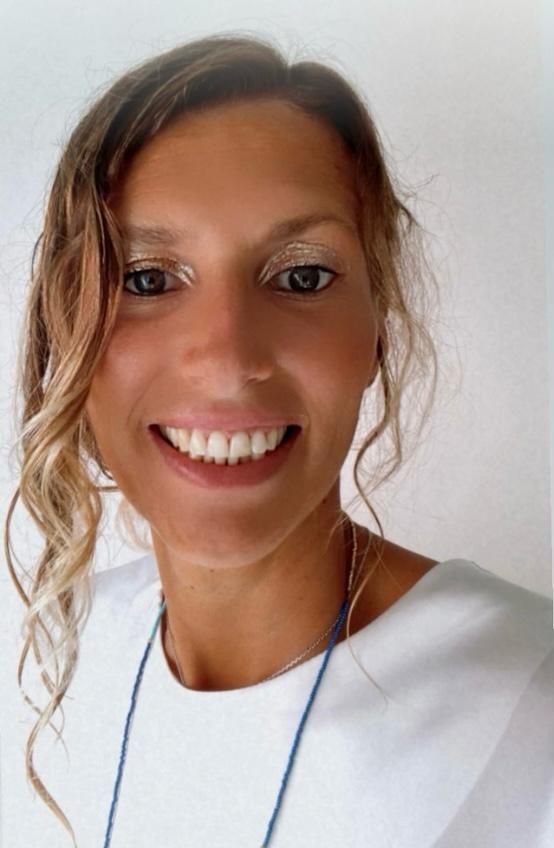
Some artists sculpt with their hands, and others sculpt with time. Silvia Corti does both. Her work is not merely a result; it is a process of alchemical listening, a sensitive excavation of matter’s inner life. Her surfaces do not remain still. They shimmer, breathe, and react. They are not objects to be observed but presences to encounter, like veils drawn over a pulse that still beats beneath.
Silvia’s story began in Como in 1981, taking shape at the hazy threshold between the lake’s reflective surface and the rhythmic play of light upon the water. Those reflections, ephemeral and luminous, became her first contact with the mysteries of form. As a child, she filled her notebooks with detailed sketches, as if drawing were a means of inhabiting space, of transforming vision into relation. That early, instinctive desire to feel the world through form has evolved into a mature artistic language, one that fuses craft and emotion, intuition and philosophical depth.
Silvia Corti is now an artist, photographer, and art therapist whose multidisciplinary practice spans sculpture, painting, installation, photography, and contemporary jewellery. Across all these media, a common thread persists: the exploration of metamorphosis, of presence, of tactile poetics. Her works are not defined by what they represent but by what they evoke. Each piece is an encounter: visceral, delicate, open-ended. Her artistic voice moves through oxidation, layering, reflection, and silence. And through that silence, she invites the viewer to listen with the skin.
Educated in both the technical and expressive dimensions of making, Silvia earned a Bachelor of Fine Arts with a specialisation in Metal Art from the University of Gothenburg. She deepened her engagement with the therapeutic dimensions of creation through a Master’s degree in Art Therapy and Expressive Therapies. Her training includes further certifications in jewellery design and goldsmithing from institutions in Italy and India; disciplines that ground her sensitivity to material in the precision of handcraft.
At the heart of her practice is the act of transformation. She works with copper, aluminium, and iron; metals that, under her care, reveal their vulnerability and their power. Exposed to oxidation, humidity, and chemical reactions, these materials are not forced but are accompanied to change. What emerges are textures that resemble skin, patinas that feel like breath, chromatic depths that shift with the light. In her process, time is not linear; it is atmospheric, cyclical, and intimate. She does not impose form; she follows the clues of the material, allowing every reaction to be both intentional and unexpected.
This philosophy extends into her photographic work, where light is not merely illumination but a tactile presence and a sculptural force. She photographs with the same sensitivity with which she sculpts: seeking reflections, refractions, and intimate thresholds. Her engagement with art is also deeply relational. As an art therapist, she creates spaces where artistic gestures become languages of care, connection, and transformation. In these settings, the material is not a tool of expression but a partner in presence.
The dialogue between inside and outside, between seen and sensed, permeates all her works. Her contemporary jewellery, developed through the co-founded project Maquette, is not an accessory but wearable narratives. Sculptural, emotional, and dreamlike, they contain fragments of stone, oxidised metal, and intuitions solidified into form. These pieces are microcosms of her larger practice: tactile poetries, meant to be lived.
Silvia’s aesthetic universe draws strength from phenomenology and poetics. Thinkers like Maurice Merleau-Ponty and Juhani Pallasmaa inform her sense of space, embodiment, and perception. For Merleau-Ponty, perception is flesh; lived and living; and for Pallasmaa, art must return to the body, to silence, and to texture. These ideas live in Silvia’s works, not as references but as sensations. Her surfaces are never decoration; they are thresholds, membranes, and memory fields.
In a time dominated by rapid visual consumption, Silvia Corti offers something rare: slowness, depth, presence. Her surfaces are not to be understood; they are to be met. Her objects do not shout; they hum. Every piece is a soft insistence that what matters is not only what we see, but how we feel it. Through her hands, the material becomes alive. And in that aliveness, we are invited to return, gently and attentively, to our own.